How to choose the right aerial hoop size?
Choosing the right aerial hoop size is important for comfortable performance of elements during both training and shows. A hoop that is too small may restrict movement, while one that is too large can make certain poses and transitions more difficult.
When choosing a size, you should consider not only your height but also your individual body proportions, skill level, performance style, and the size of the hoop you are already used to training on.
Let’s look at how an aerial hoop is measured, how to determine the right diameter, and what to do if your measurement falls between two sizes.
How is aerial hoop size measured?
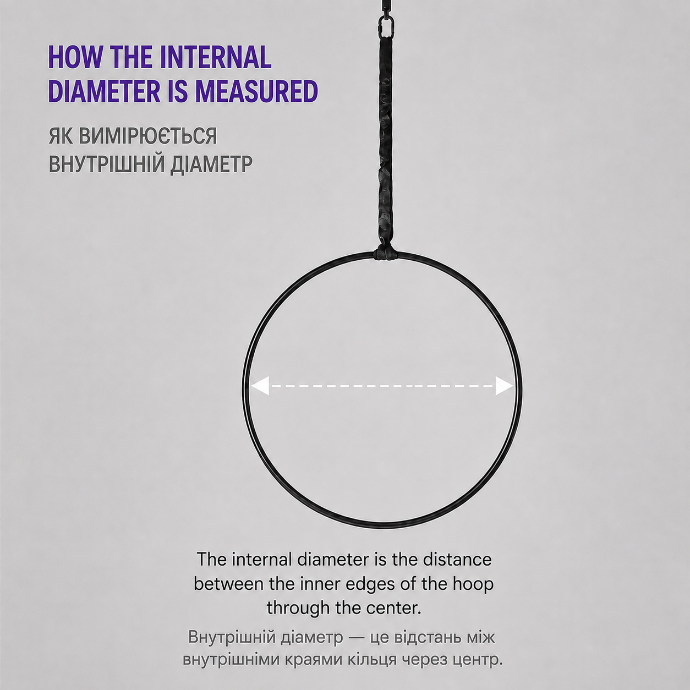
The size of an aerial hoop is determined by its internal diameter — the distance between the inner edges of the hoop measured through its center.
For example, if the stated size is 95 cm (37.4 in), this means that the internal diameter of the hoop is exactly 95 cm (37.4 in).
When comparing different aerial hoops, it is important to pay attention specifically to the internal diameter.
What aerial hoop diameter should you choose?
One of the most versatile and commonly used sizes for adults is an aerial hoop with an internal diameter of 95 cm (37.4 in).
As a general guideline, you can consider the following sizes:
| Internal diameter | General recommendation |
|---|---|
| 90 cm (35.4 in) | for shorter aerialists |
| 95 cm (37.4 in) | a versatile and one of the most commonly used sizes |
| 100 cm (39.4 in) | for taller aerialists |
However, these recommendations are only approximate.
Choosing an aerial hoop based solely on height is not always accurate. Two people of the same height may have different leg and torso proportions, so individual body proportions should also be taken into account.
For a more accurate estimate, you can use two simple measuring methods.
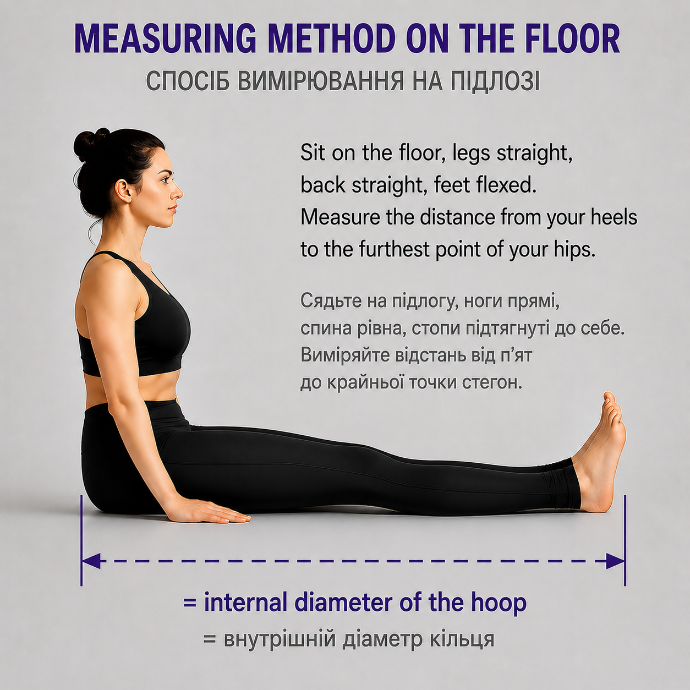
Method 1. Measuring while sitting on the floor
Sit on the floor with your legs straight in front of you. Keep your back straight and flex your feet towards you.
Measure the distance from your heels to the furthest point of your hips.
The resulting measurement can be used as a guideline for choosing the internal diameter of your aerial hoop.
This method helps take individual body proportions into account rather than relying solely on overall height.
Method 2. Measuring while sitting on a chair
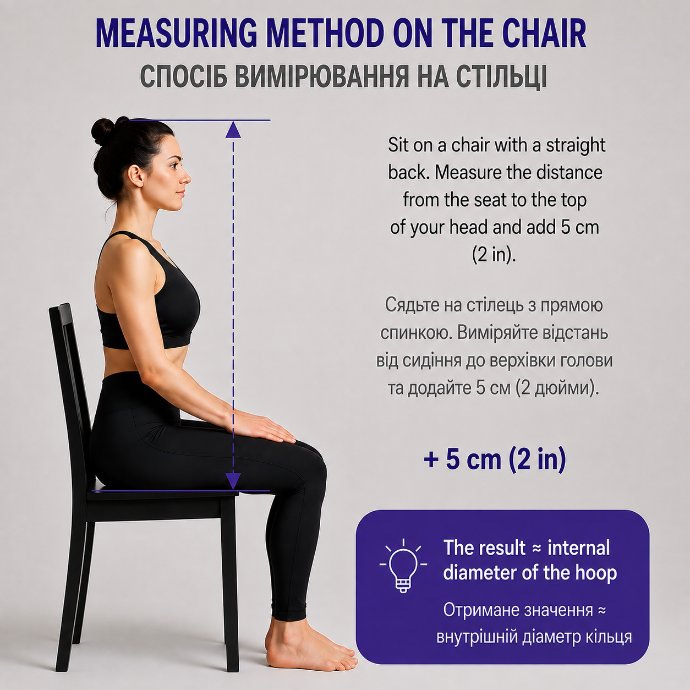
Sit on a chair with a straight back and keep your back upright.
Measure the distance from the surface of the seat to the top of your head.
Add approximately 5 cm (2 in) to the result.
For example, if the distance from the seat to the top of your head is 90 cm (35.4 in):
90 cm + 5 cm = 95 cm (35.4 in + 2 in ≈ 37.4 in)
In this case, you can consider an aerial hoop with an internal diameter of approximately 95 cm (37.4 in).
Which sizing method is better?
Both methods provide an approximate result. There is no single universal formula that can determine the ideal aerial hoop size for every aerialist.
In addition to body measurements, your choice may depend on:
- your skill level;
- the elements you perform;
- your performance style;
- your individual body proportions;
- your personal preferences;
- the size of the hoop you already train on.
If you train at an aerial studio or circus school, check the diameter of the hoop you currently use.
If you feel comfortable performing your main elements on it, this size can be a good starting point when choosing your own aerial hoop.
What if your measurement falls between two sizes?
For example, your measurement may be 97 cm (approximately 38.2 in). This does not necessarily mean that you need an aerial hoop with exactly this diameter.
If your measurement falls between two standard sizes, there are several factors to consider.
First, think about the hoop you currently train on. If you know its size and feel comfortable performing your main elements on it, this can be an important reference point.
You should also consider your body proportions, performance style, and the elements you plan to perform.
For beginners, a coach’s recommendation can be particularly helpful in this situation. Experienced aerialists often choose their hoop size according to their own technique and personal preferences.
How to choose an aerial hoop size for a child
When choosing an aerial hoop for a child, you should not rely solely on age.
Children of the same age can differ significantly in height and body proportions. It is therefore better to take individual measurements using one of the methods described above and consider the coach’s recommendation.
It is also not advisable to automatically choose a significantly larger hoop “to grow into.” If the hoop is too large for the child at the moment, some exercises and transitions may be uncomfortable to perform.
The best option is to choose the diameter according to the child’s current measurements and training programme.
Is the hoop size different for beginners and professional aerialists?
For beginners, individual measurements and a coach’s recommendation are a good starting point. It is also useful to consider the size of the equipment used during regular training.
Experienced aerialists may approach the choice differently.
A professional aerialist may intentionally choose a smaller or larger hoop depending on their body proportions, technique, selection of elements, and the requirements of a particular act.
For this reason, two aerialists of the same height do not necessarily use aerial hoops of the same diameter.
How to choose an aerial hoop size: a quick checklist
If you are choosing your first aerial hoop:
- Determine the approximate diameter based on your body measurements.
- Take individual measurements using one of the methods described above.
- Compare the result with the size of the hoop you currently train on.
- Consider your body proportions and the elements you plan to perform.
- If you are unsure between two sizes, consult your coach.
Remember: size charts and measuring methods provide guidance rather than an absolute rule. The optimal aerial hoop size depends on the individual aerialist, their body proportions, technique, and performance style.
Frequently asked questions
What is a standard aerial hoop size?
One of the most versatile and commonly used sizes for adults is 95 cm (37.4 in) internal diameter. However, the optimal size depends on the aerialist’s height, body proportions, and individual preferences.
How is an aerial hoop measured?
The size of an aerial hoop is determined by its internal diameter — the distance from one inner edge of the hoop to the opposite inner edge through the center.
Can I choose an aerial hoop size based only on height?
Height can be used as a general guideline, but it is better to consider individual body proportions and take additional measurements.
What if my measurement falls between two sizes?
Consider the size of the hoop you already train on, your body proportions, the elements you perform, and your coach’s recommendation. You do not necessarily need to order a hoop with a diameter that exactly matches the measurement you obtained.
What aerial hoop size should I choose for a child?
It is better to consider the child’s current measurements and body proportions rather than age alone. A coach’s recommendation can be particularly helpful when choosing an aerial hoop for a child.
Can I order a custom-size aerial hoop?
If standard sizes do not meet your needs or you require a different diameter for a particular act, the aerial hoop dimensions can be determined individually.
If you still have questions:
- Write to info@circusforyou.com.
- Contact us via messaging apps (links at the top of the site) or on social media.
Ordering air hoop through our website is easy — simply add them to your shopping cart.