How to choose aerial straps and long loops?
Aerial straps are popular equipment for aerial gymnastics, used for strength elements, hangs, spins, inversions, and acrobatic combinations. At first glance, different models may look similar, but when choosing the right equipment, it is important to consider the material, width, length, loop design, and intended use.
In this article, we will look at the main types of strap-based aerial equipment and the key factors to consider when choosing equipment for training or performances.
If you are interested in short aerial loops, we recommend reading the article “How to choose the right hand loops”.
Long loops
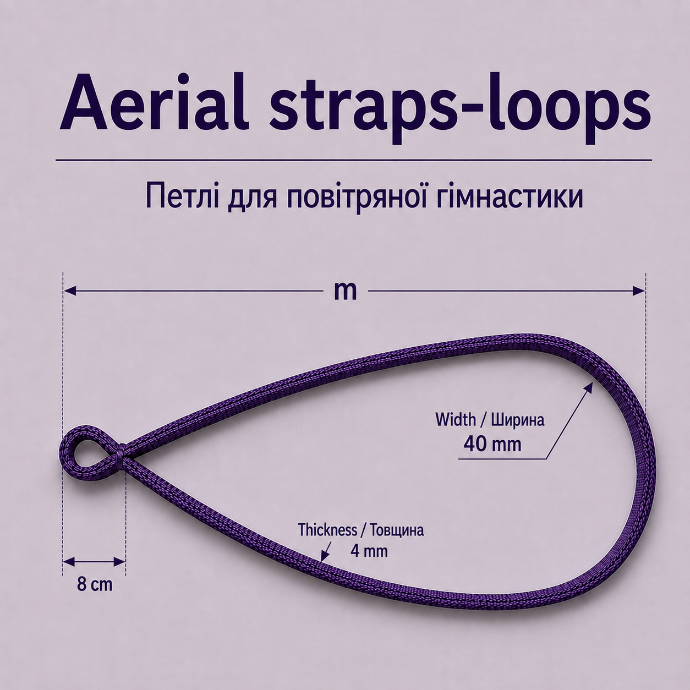
Long aerial loops are two separate straps, each forming a closed loop. This design allows the performer to work inside the loops, using them for various acrobatic and strength elements.
The length of the long loops determines the amount of available free space and the ways they can be used. Therefore, when choosing the appropriate length, it is important to consider not only the performer’s height but also the suspension height and the type of routine.
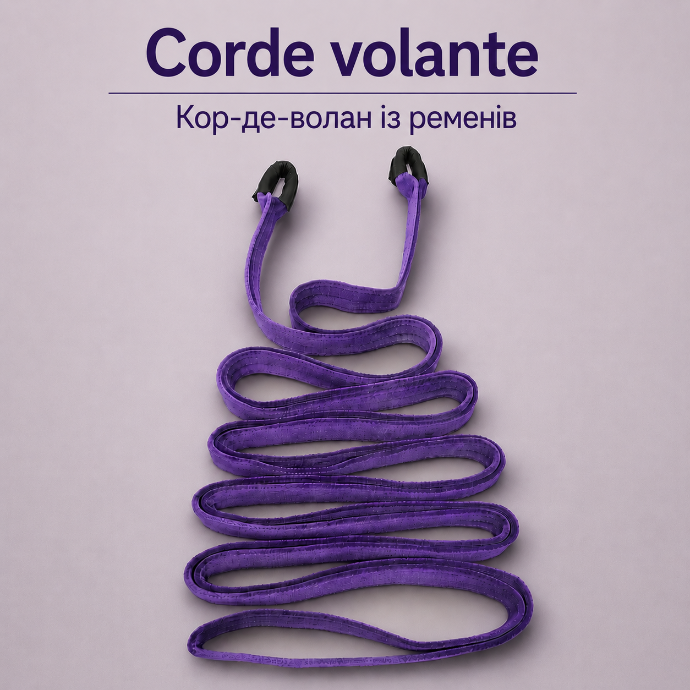
Corde volante
Corde volante made from straps is a construction consisting of a strap with carabiner attachment points at both ends. The two ends of the same strap are attached to suspension points at a certain distance from each other, so the strap forms a shape resembling the letter “V”.
As a rule, a corde volant consists of two such straps suspended in parallel. This construction allows the performer to perform various acrobatic and strength elements.
The main difference between a corde volant and long aerial loops is the upper attachment: with a corde volant, the two ends of the strap have separate attachment points, positioned at a distance from each other. With a long aerial loop, the two ends are connected to a single upper attachment point, forming a closed loop.
Aerial straps
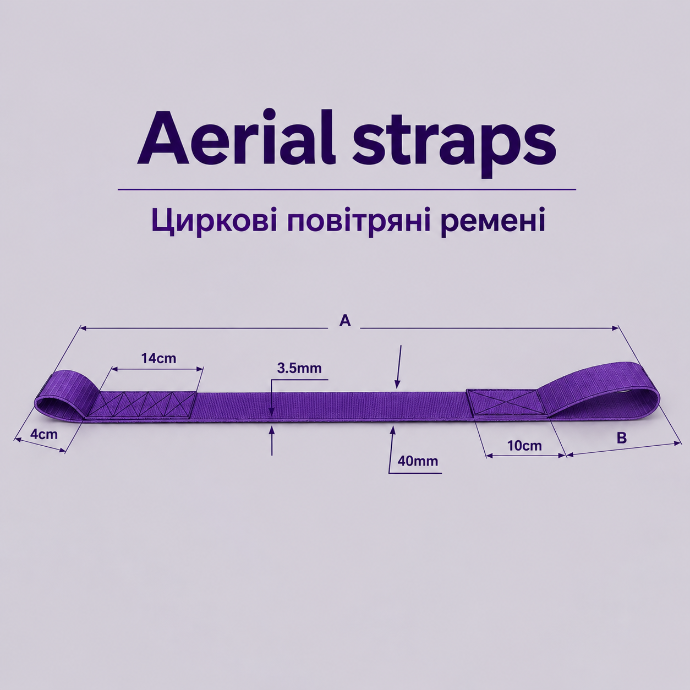
Aerial straps consist of two separate webbing straps, each ending in loops for the hand or foot.
Unlike long loops, the straps do not form closed loops. The performer works with two separate straps, using them for strength, acrobatic, and other aerial elements.
The loops at the ends of the straps can be designed for the hands or feet. The standard hand loop length is 14 cm (5.5 in). If you plan to put a foot through the loop, we recommend a loop length of 20–22 cm (7.9–8.7 in).
These are the most common sizes, but loops can be custom-made in any required length upon request.
For loops longer than 16 cm (6.3 in), we additionally recommend using ring band, which help secure the loop around the hand or foot.
What to consider when choosing
When choosing aerial straps or long loops, it is important to consider the construction, length, width and thickness of the webbing, outer covering, type of attachment, and suspension system.
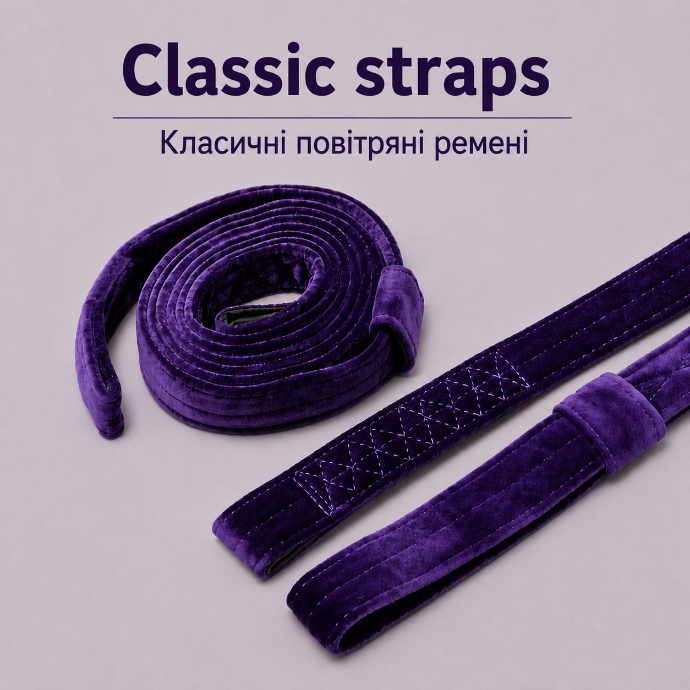
Self-tightening and classic straps
Depending on their construction, aerial straps can be classic or self-tightening.
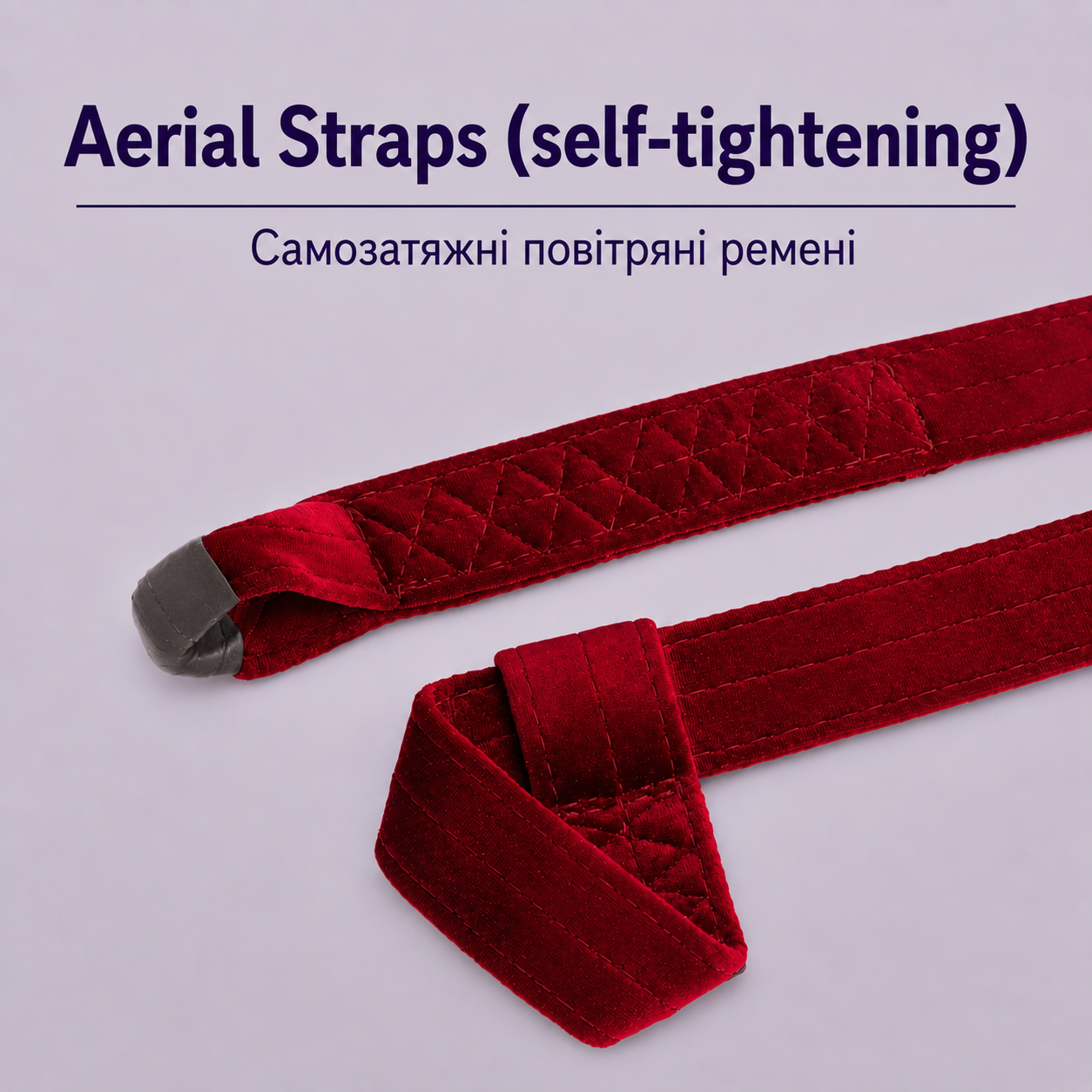
Aerial straps (self-tightening) are a versatile option: under the performer's weight, the loop tightens around the hand or foot, helping to keep it securely in position.
Classic straps have a standard loop without this tightening mechanism. The choice between the two options depends on the performer's technique and how the equipment will be used.
Length of long loops
The most common length for long aerial gymnastics loops is 2.5–3 m (98–118 in). We make long loops in lengths from 1.5 to 4 m (59–157 in), allowing you to choose a suitable size depending on the suspension height, the performer’s height, and the intended use of the equipment.
Length of aerial straps
The most common length for aerial straps is 3–4 m (118–157 in). We make straps in lengths from 1.5 to 10 m (59–394 in).
Longer straps are used, for example, for performances that include wrapping elements. Working with longer straps requires sufficient ceiling height so that the performer can make full use of their length.
Shorter straps are convenient for training in spaces where there is no possibility of installing a high suspension point.
Width
When choosing the width, it is important to consider not only the technical characteristics but also which option feels most comfortable for the individual performer.
For our aerial straps, we use 40 mm (1.57 in) wide webbing. It provides a sufficient contact area for the hands and body while remaining suitable for a variety of aerial elements.
Thickness
The thickness of the strap does not determine its reliability. It primarily affects how the strap feels during use and how thick the material feels in the hand.
We manufacture straps with a thickness of 2.5 mm (0.10 in) or 3.5 mm (0.14 in).
To increase the thickness and make the strap feel softer in the hand, an additional cotton webbing layer is sewn onto the nylon webbing.
For long straps used in performances with wrapping and winding elements, 2.5 mm (0.10 in) thickness is recommended. This option is easier to wrap and does not create unnecessary bulk.
Outer covering
The outer covering should be chosen according to how the equipment will be used.
For performances, the following coverings can be used:
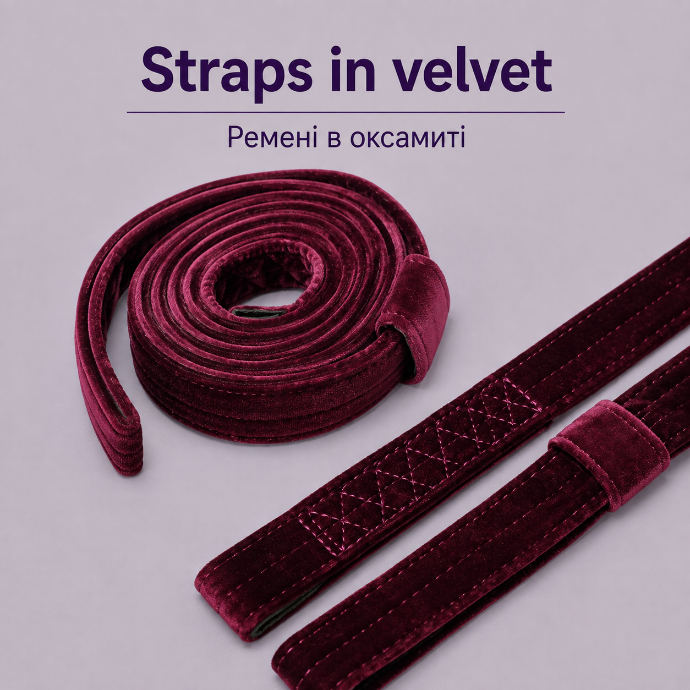
- cotton covering;
- velvet covering.
Velvet has a soft, pleasant texture and is well suited to stage performances. At the same time, it is a delicate fabric, so with intensive use, signs of wear may appear over time.
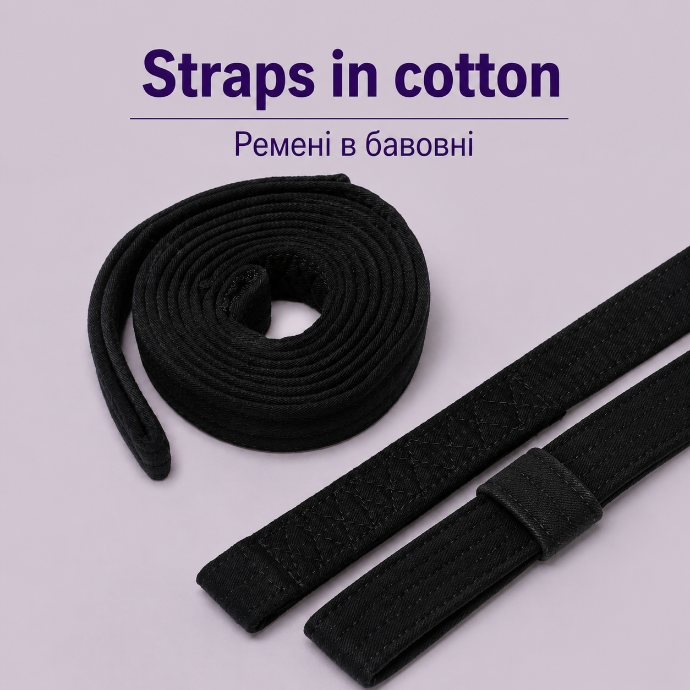
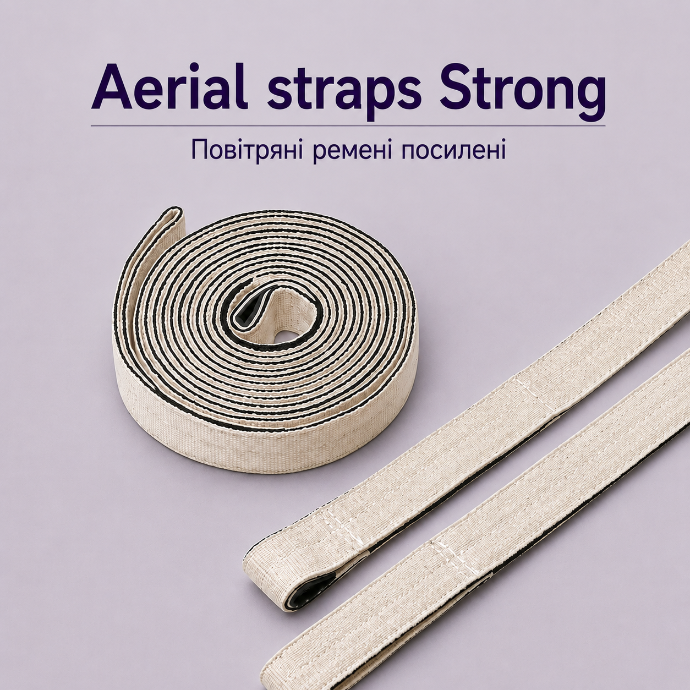
For regular training, we recommend reinforced three-layer aerial straps. In this construction, cotton webbing is sewn onto both sides of the nylon webbing. This creates an additional layer of material and provides greater comfort and wear resistance during intensive use.
For regular training and performances, it is convenient to have two pairs of straps or loops: one pair for training and another for performances. This allows you to choose different coverings depending on how the equipment is used and helps keep your performance equipment in better condition.
We offer a discount on the second pair of straps or loops.
Attachments
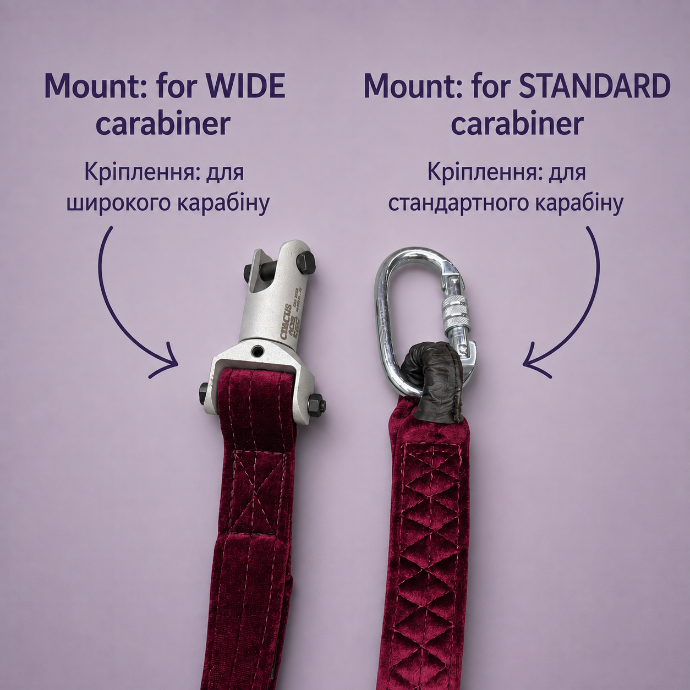
Two main types of attachments are available for aerial straps and long loops:
- for a wide carabiner or swivel;
- for a standard carabiner.
The appropriate attachment depends on the suspension system to which the equipment will be connected. Therefore, before ordering, it is important to consider not only the strap or loop itself but also the equipment with which it will be used.
Suspension
For full and comfortable use of aerial straps and long loops, an appropriate suspension system is required.
One option consists of three swivels and a steel triangle.
This setup allows the equipment to be suspended and provides the possibility of rotation when performing elements that require it.
When choosing a suspension system, make sure that all components are compatible with each other and are suitable for the intended load.
Safety when using aerial straps and long loops
Even high-quality circus equipment must be used correctly. Safety depends not only on the strap or loop itself but on the entire system, including the suspension point, connecting elements, installation method, condition of the equipment, and the performer's technique.
Before each use, inspect the equipment and check:
- the condition of the webbing;
- stitching and connection points;
- loops;
- signs of abrasion, cuts, or other damage;
- deformation or signs of excessive loading;
- the condition of all attachment components.
Do not use a damaged strap or loop until its condition and suitability for use have been properly assessed.
It is also important not to confuse the strength of an individual material with the permissible working load of the entire system. Safe operation depends on all components of the suspension system, not just the characteristics of the webbing.
Conclusion
When choosing aerial straps and long loops, it is important to consider more than just the appearance of the equipment. Key factors include the construction, length, width, thickness, outer covering, type of attachment, and suspension system.
A long loop consists of a single webbing strap suspended by both ends from one upper attachment point. Aerial straps consist of two separate straps with loops for the hands or feet. Corde volante has two separate upper attachment points at the ends of a single strap. Each construction has its own characteristics and is suited to different types of use.
For training and performances, it is also important to choose the appropriate length and thickness, outer covering, and attachment type. If you are unsure which option is best suited to your routine or training conditions, it is worth discussing the required specifications with the manufacturer in advance.
If you still have questions:
- Write to info@circusforyou.com.
- Contact us via messaging apps (links at the top of the site) or on social media.
Ordering aerial straps through our website is easy — simply add them to your shopping cart.