Rigging sets for aerial straps: components, selection, and safety
Aerial straps are dynamic circus apparatus, and safe work with them depends not only on the straps themselves but also on a properly designed rigging system. The system consists of several components that must be compatible with one another and suitable for the loads generated during use.
For rigging, you can use individual components or a ready-made rigging set in which the main elements have already been selected as a specific configuration.
What is included in an aerial straps rigging set?
Depending on the design, a rigging set may include:
- a triangular plate;
- swivels;
- carabiners;
- shackles;
- rigging slings;
- other connecting components.
The exact configuration depends on the rigging point, the design of the straps, and how the components are connected.
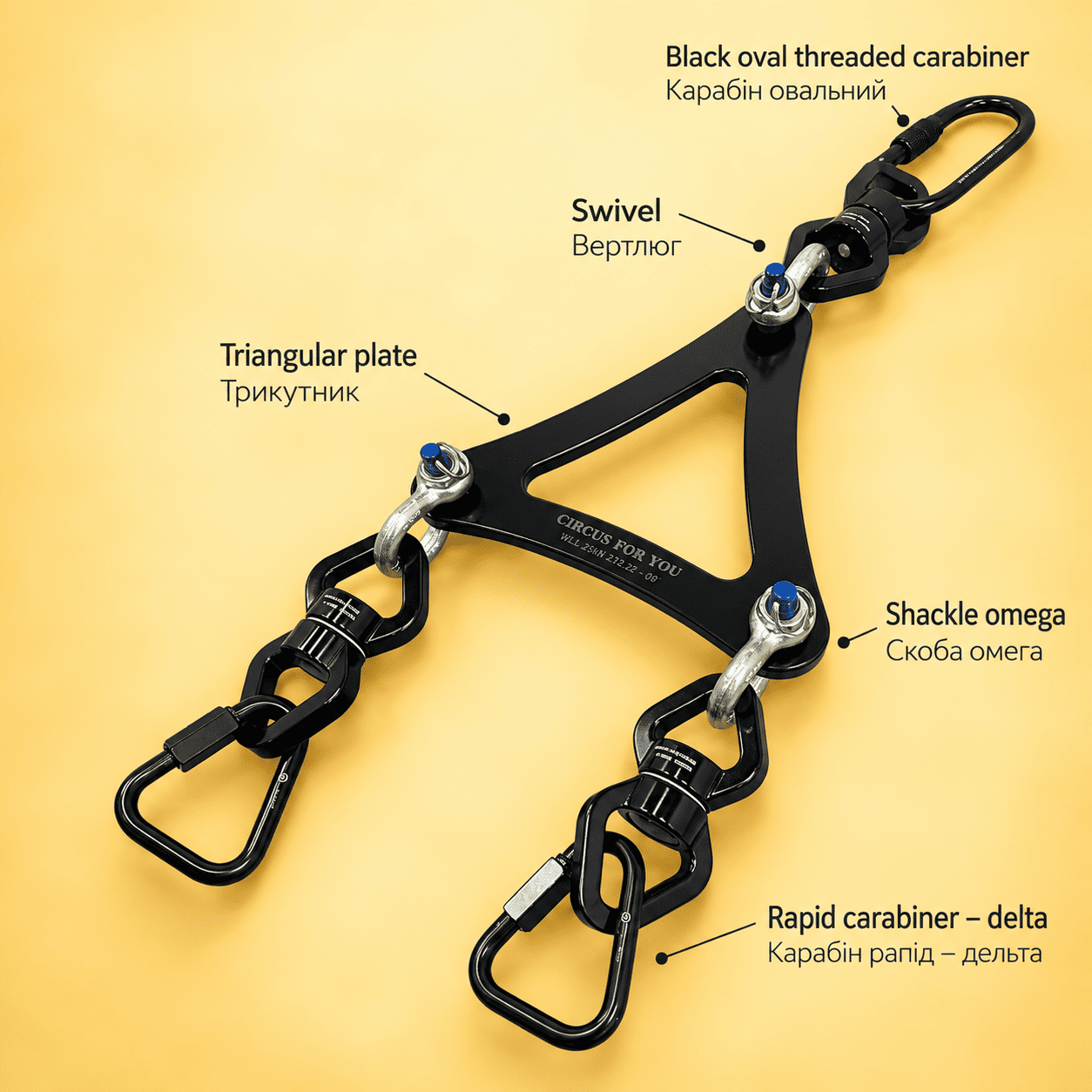
Usually, the aerial straps themselves are not included in the rigging set. The set contains the components used to connect and suspend the straps. This means that the straps and their rigging system can be selected separately, taking into account the design of the apparatus and the conditions in which it will be used.
If you are still choosing your aerial straps, you can learn more about their construction, length, and other characteristics in the article “How to choose aerial circus straps and long loops.”
It is important to evaluate not just individual components but the complete assembled system: its design, component compatibility, working loads, and method of attachment.
The classic rigging configuration for aerial straps and loops
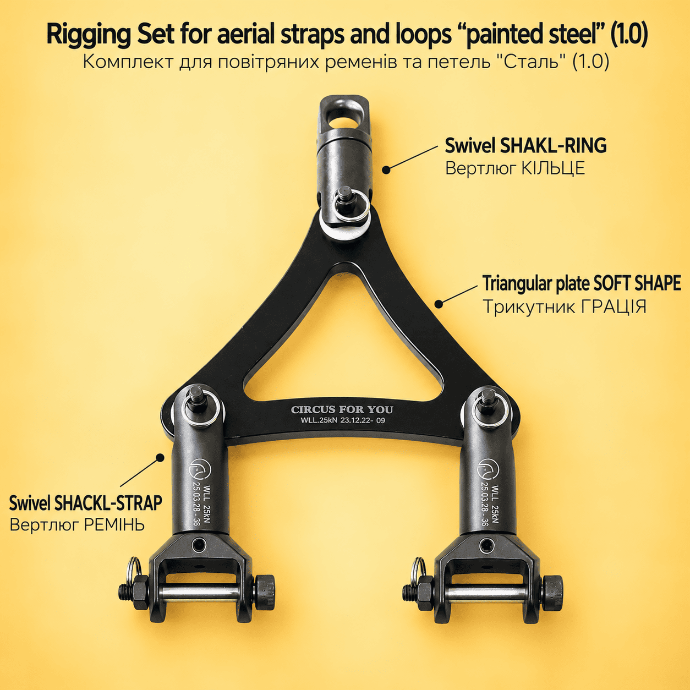
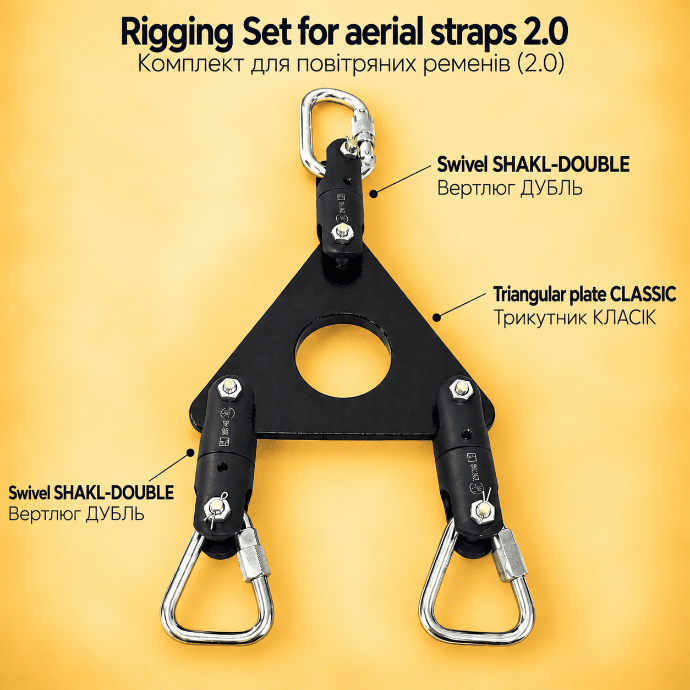
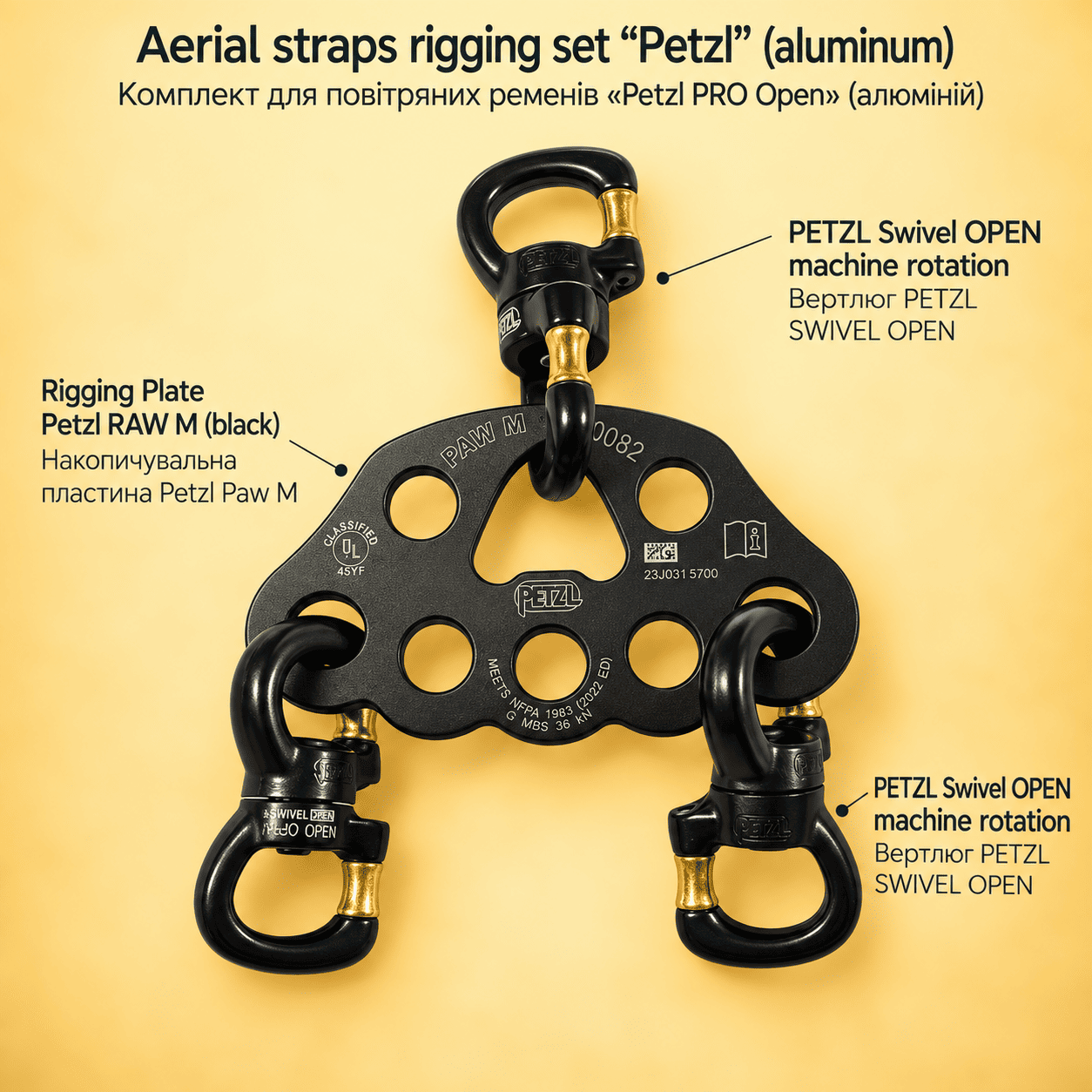
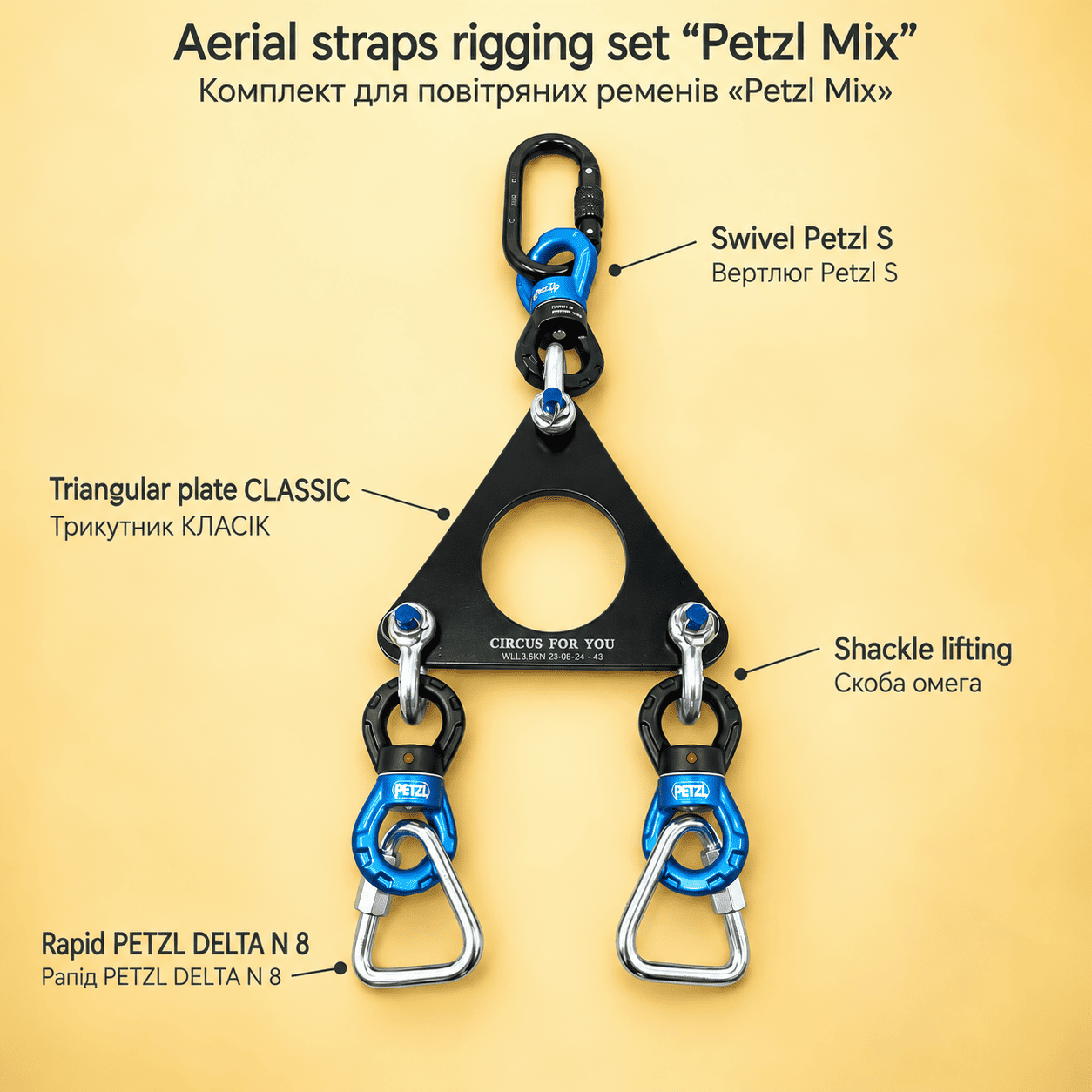
The classic rigging configuration for aerial straps or loops is usually built around a triangular plate.
This configuration uses three swivels.
Two lower swivels are attached to the individual straps, one swivel for each strap. They allow each strap to rotate independently around its own axis.
The upper central swivel is installed between the carabiner and the triangular plate. It allows the entire system to rotate around its central axis.
In this configuration, the lower swivels provide individual rotation of the straps, while the central swivel allows the entire rigging system to rotate. These movements can occur independently of one another.
Schematically, the system looks like this:
carabiner → central swivel → triangular plate → two swivels → two straps
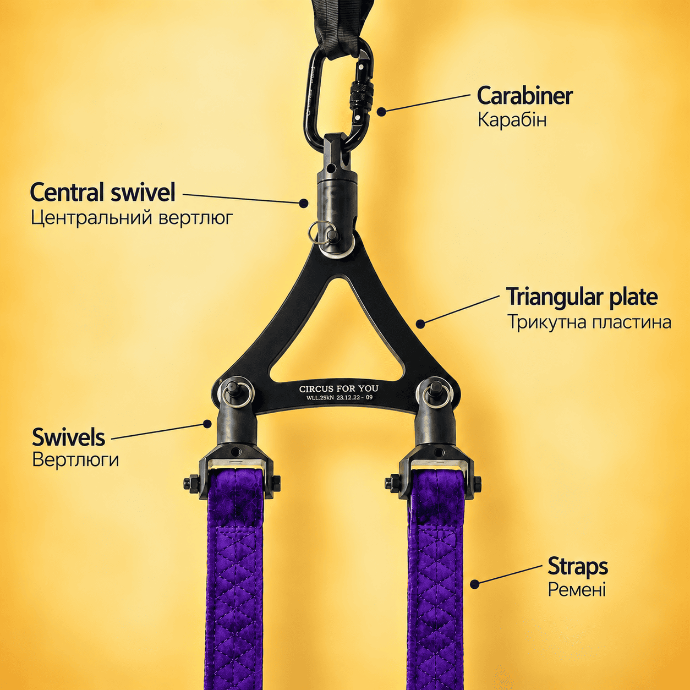
This is the basic configuration. The number of additional connecting components depends on the design of the individual swivels and other components.
How to choose rigging components
When choosing components, it is important to consider not only their strength and working load but also their material, design, and method of connection.
First, determine the type of aerial apparatus, the rigging point, and the required rotation configuration. It is also important to consider the overall height of the rigging system. In venues with limited ceiling height, unnecessary carabiners, shackles, and other intermediate components can reduce the available working length of the straps.
Steel or aluminum
Steel components offer high strength, durability, and resistance to impact. Their main disadvantage is their greater weight.
Aluminum components are lighter, which can be important for mobile or frequently transported equipment. At the same time, aluminum is more sensitive to impacts and drops. After a significant impact, hidden damage to an aluminum component may not always be visible from the outside, so the component should be carefully inspected or replaced.
For more information about the properties of different metals and their use in circus equipment, see the article “Stainless steel, mild steel, or aluminum: which metals are used for circus equipment and why.”
Number of connections
It is preferable to use the minimum number of necessary additional connecting components in a rigging system.
This keeps the configuration more compact, reduces its overall height, and limits the number of potential wear points.
Some swivels can be attached directly to the triangular plate without an additional carabiner or shackle, such as the RING Swivel.
Swivels with a specially designed wide fork, such as the STRAP Swivel, allow the strap to be attached directly without additional connecting components.
Therefore, when selecting components, it is important to consider not only the specifications of individual parts but also how exactly they will be connected to one another.
Circus For You rigging sets
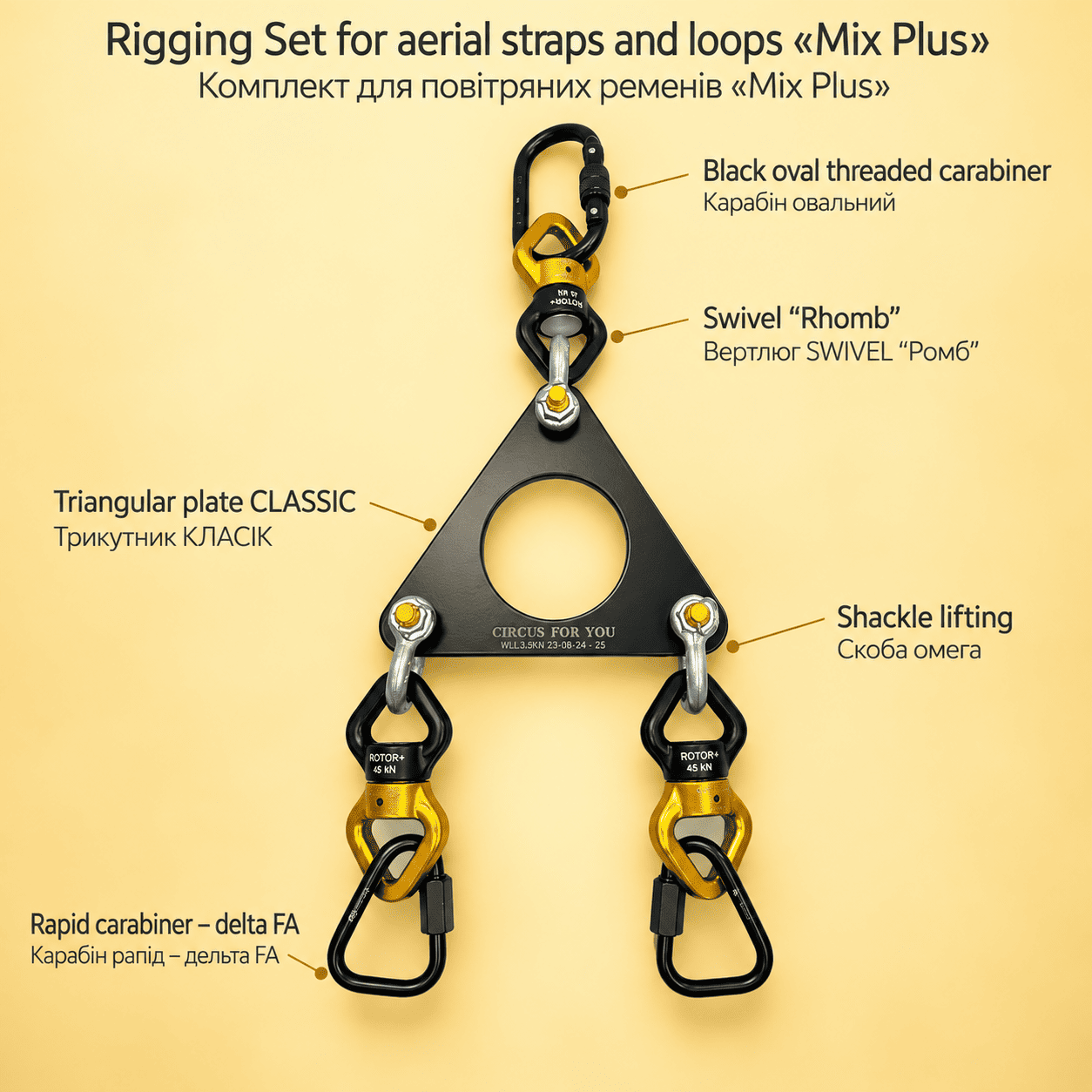
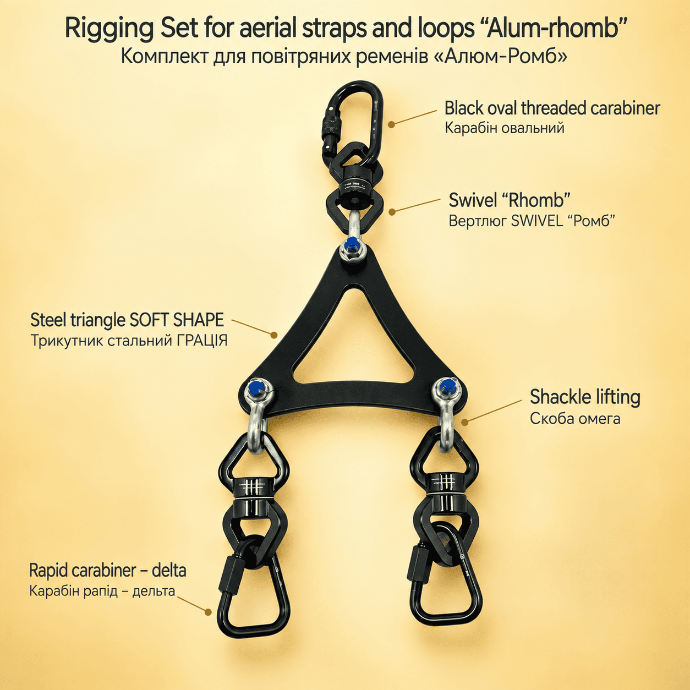
At Circus For You, our rigging sets for aerial straps are assembled from carefully selected components that are compatible in terms of their design and intended use.
Depending on the specific configuration, our sets may include both steel and aluminum components. When assembling a set, we take into account the characteristics of each component and its compatibility with the complete system.
Each rigging set is assembled and inspected in our workshop. The sets are supplied with product documentation and test reports.
A ready-made rigging set is therefore not simply a random collection of individual components, but a selected and tested configuration designed for suspending aerial straps.
Safety when using aerial straps rigging
The safety of a rigging system depends on every component — from the rigging point and triangular plate to the swivels, carabiners, slings, and the apparatus itself.
Before use, all equipment should be inspected for:
- cracks or deformation;
- damaged threads;
- signs of corrosion;
- unusual play or looseness;
- damage to slings;
- other signs of wear or mechanical damage.
Equipment should be inspected particularly carefully after a fall, impact, or other abnormal loading event.
The safety of a rigging system cannot be assessed based on the specifications of a single component alone. It is necessary to consider dynamic loads, compatibility between all components, and the strength of the rigging point itself.
Each component must be used according to its intended purpose and the manufacturer's recommendations. The rigging point, truss, beam, or other supporting structure must also be designed and rated for the loads involved.
Conclusion
The classic rigging system for two aerial straps is based on a triangular plate and three swivels: the two lower swivels provide independent rotation of the straps, while the upper central swivel allows the entire system to rotate.
When choosing a rigging set, it is important to consider not only the strength of individual components but also their material, method of connection, overall system height, component compatibility, and the characteristics of the rigging point.
The more carefully the system is designed, the fewer unnecessary intermediate connections, excess length, and potential wear points it will contain.
If you still have questions:
- Write to info@circusforyou.com.
- Contact us via messaging apps (links at the top of the site) or on social media.
Ordering aerial straps rigging sets through our website is easy — simply add them to your shopping cart.